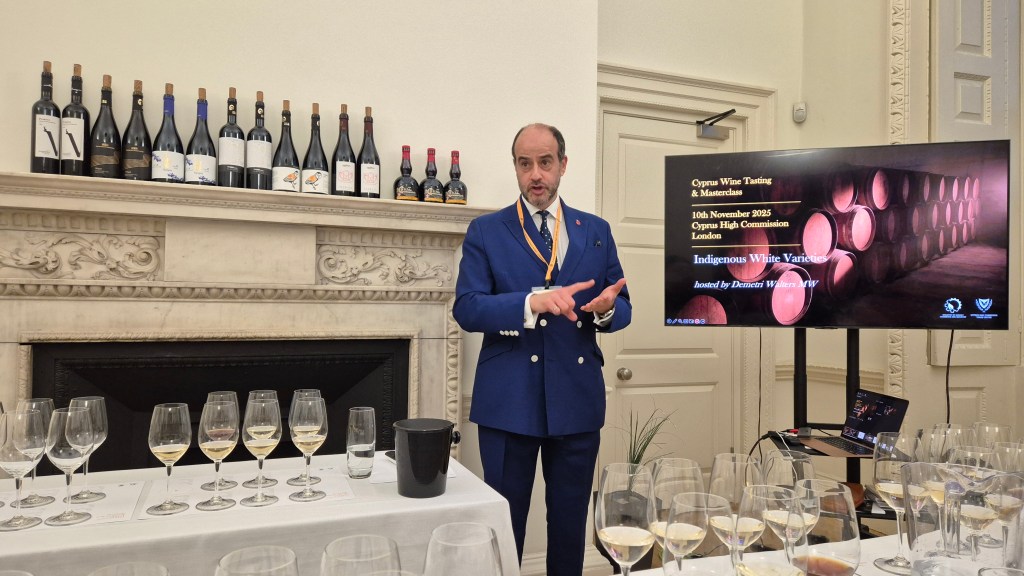
On Monday this week, the Cyprus High Commission in London hosted a walk around tasting of wines from Cyprus, with fourteen producers on show. In addition, Demetri Walters MW delivered two masterclasses, first whites and then reds.
For the cognoscenti, Cyprus wine is full of interest. The island has a very long tradition of winemaking – 5,500 year old wine jars have been unearthed at Erimi near Limassol, appropriately the location of the fascinating Cyprus Wine Museum. The island is free of phylloxera and most vines are ungrafted. It has dozens of indigenous grape varieties, mostly not yet genetically analysed. And the luscious sweet wine Commandaria, originally called Nama, is the world’s oldest extant wine style.
But the typical wine buyer, looking for an affordable but interesting bottle on a shelf or list, knows little of this. Cypriot wine is in there jostling for shelf space and attention alongside dozens of other wine regions, many much better known. So what does it have to offer the consumer?
The Wine Society offers one answer: it currently stocks three wines by Makarounas Winery: Aerides Xynisteri, a Spourtiko and a Maratheftiko. All three grapes varieties are indigenous to the island. Xynisteri is Cyprus’s dominant white grape; Spourtiko is a white grape that is being gradually rescued from near extinction; the red Maratheftiko is often coplanted with Spourtiko to aid fertilisation. Absent from this list is the dominant red grape, Mavro (possibly but probably not also indigenous), and there is a reason: in the words of Wine Grapes, it makes undistinguished wine. The other varieties, however, are splendid.
Well done to The Wine Society, but Cyprus offers much else. Demetri’s white masterclass also included a Vasilissa by Oenou Yi – a delicious vinous take on lemon sherbet; a Promara (a.k.a. Bastartiko, so rare that it is absent from Wine Grapes), showing stone fruits such as peach and a long finish; and a Morokanella (also missing from Wine Grapes), making lightly spiced wine (kanella is cinnamon, as well as a Cretan dance…)
The red masterclass showed two varietal Maratheftiko wines, a Maratheftiko-Mavro blend; a varietal Yiannoudi – thought of as the best Cypriot red, with fine tannins; a Yiannoudi-Syrah blend, a Lefkada (a.k.a. Vertzami); and finishing of course with a Commandaria.
These are good wines! So back to the question as to Cyprus’s wine offer. Cyprus shares an issue with many other ancient wine kingdoms: should it concentrate on its indigenous varieties – which are mostly unknown, not always very good, and sometimes unpronounceable – or go for French and international varieties? Whereas large countries can make a success of both without a threat to their image– such as Cabernet Sauvignon from Bolgheri in Italy – countries in revival must consider their identity more carefully. The answer is usually, and definitely for Cyprus, the indigenous varieties. Though it might be entirely a hand sell at first, the strength and uniqueness of the products and their stories are in the long run better arguments for gaining shelf space than pushing yet another Cab or Merlot, and the world of wine is richer for it.
But this strategy can only work if the wines meet consumers’ expectations. An older generation of Cypriots made wine for themselves, not least Zivania, a pomace brandy first mentioned in Homer’s Odyssey, which was widely sipped throughout a meal. Internationally, though, its place is rather as an aperitif, digestive or in cocktails. The table wines must also meet modern tastes. This has not escaped the attention of the current generation of winemakers in Cyprus: boutique and artisan vignerons bringing new knowledge, experience and ideas, and with an eye on the export market.
So it was good to find that two other guests at the tasting – Thomas Page and Marina Nicoli – have recently set up the UK’s first Cyprus specialist: Love from Cyprus (www.lovefromcyprus.co.uk). Tom and Marina work directly with vineyards to import, promote and sell the island’s wines to both the on and off trade and events, and firmly focused on the local grape varieties. T and M have an inside track: Marina’s father is a Greek Cypriot, and she and Tom married this May in Lefkara, with the reception at Christoudia Winery.
LFC’s developing portfolio includes wines from there as well as from Krasapoulin, Constantinou and Oenou Yi. Wine styles include sparklers and rosés, while the Promara, Spourtiko, Vasilissa, Xynisteri, Lefkada, Maratheftiko and Yiannoudi grapes are all represented, and of course Commandaria.
All this bodes well for Cypriot wines in the UK market. Encourage your local taverna to improve their offering! So good luck to LFC and many thanks to the Cyprus High Commission and Demetri for a valuable and informative tasting.

 GrapeDeal.com
Leave a comment