The UK Sommelier Association kicked off its autumn season of trade tastings this week at The St. James’s Room, 67 Pall Mall. Under the title Apalta DO Decoded, the tasting on Tuesday was presented by Andrea Leon, Technical Director of Domaines Bournet-Lapostolle at Clos Apalta.
The story
The intriguing history of Clos Apalta bears a reprise. In 1827, Jean-Baptiste Lapostolle built a liqueur distillery not far from Paris. Then in 1876, his granddaughter Julia married Louis-Alexandre Marnier, whose business distributed Lapostolle’s products. Thus La Maison Marnier-Lapostolle was born. A short while after in 1880, Louis-Alexandre suggested blending Lapostolle Cognac with bitter Bigarade (Seville) oranges. He originally called this innovative liqueur Curaçao Marnier, but his good friend César Ritz suggested Grand Marnier, and its popularity at his hotel assured its success.
Leaping forward a century in time, in 1994 Alexandra Marnier Lapostolle, great-granddaughter of Louis-Alexandre, chose Clos Apalta to be the site of a new wine venture. She engaged Michel Rolland for guidance, and Clos Apalta remains the only estate in Chile that he advises.
Our presenter Andrea came on board in 2005 and has in time meticulously detailed the character of each parcel in the estate, planting varieties accordingly, and launching new wines.
The tasting
There were nine wines on tasting from across the range and price points: a rosé, a Viognier, a GSM, a Syrah, three Carménère-led blends – the third being the flagship Clos Apalta – and to finish, the infrequently produced Lapostolle La Parcelle 8 Vieille Vignes Cabernet Sauvignon, both the latter wines being from 2022.
I was not previously well acquainted with these wines, and the tasting was an eye-opener. It was striking how they demolished the jaded Old World-New World dichotomy. I dare anyone to place the rosé from here were it presented blind – it was a Provence blend and only betrayed its origins somewhat through a thankful lack of bubblegum. The Viognier, too, had all the hallmarks of Condrieu – it is indeed called their ‘Rhône Project’. Not that Viognier cannot show well in other styles, but who can deny that Condrieu is a great model to work with?
The reds were all still young but already showing their pedigree, the tannins nicely tucked in but with obvious promise of greater pleasures as the wines mature. The Syrah was the least ready, still needing time to shed some bitter cherry, best revisited a few birthdays from now. The remainder showed a clearer sense of their home. Andrea says that Carménère is soil-sensitive and grows particularly well on the granitic parcels here. Finally, the Cabernet, an intriguing wine not resembling the paradigms of Bordeaux, California or Coonawarra. Very rich and concentrated, as it might be from vines planted in 1907.
A splendid introduction to this fine estate.
Many thanks to Andrea and Ronnie Jannsen at DBL, and to Andrea Rinaldi and Federica Zanghirella at the UK Sommelier Association.
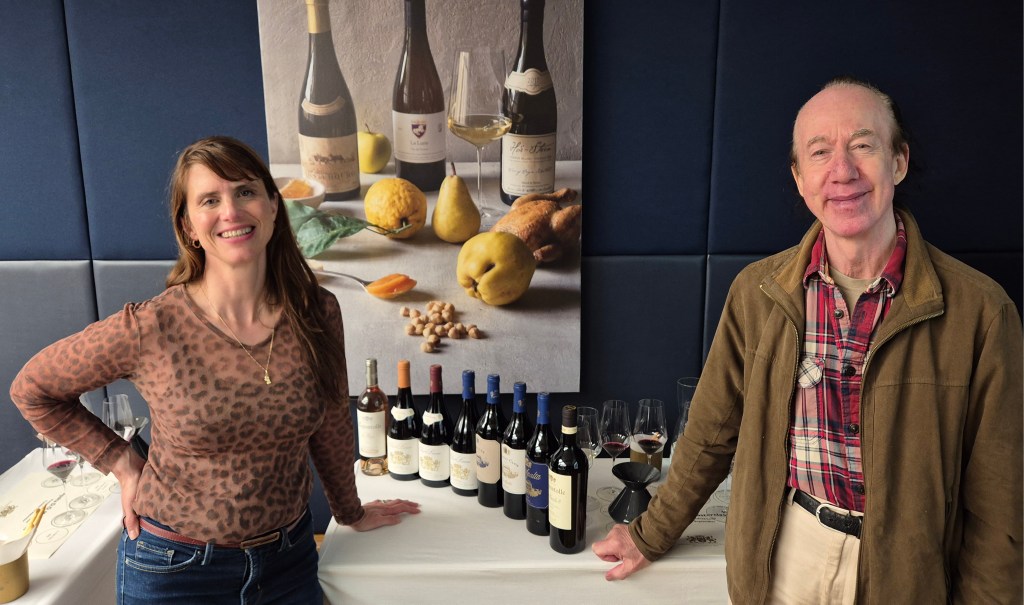
Andrea Leon, the wines and me
 GrapeDeal.com
Leave a comment