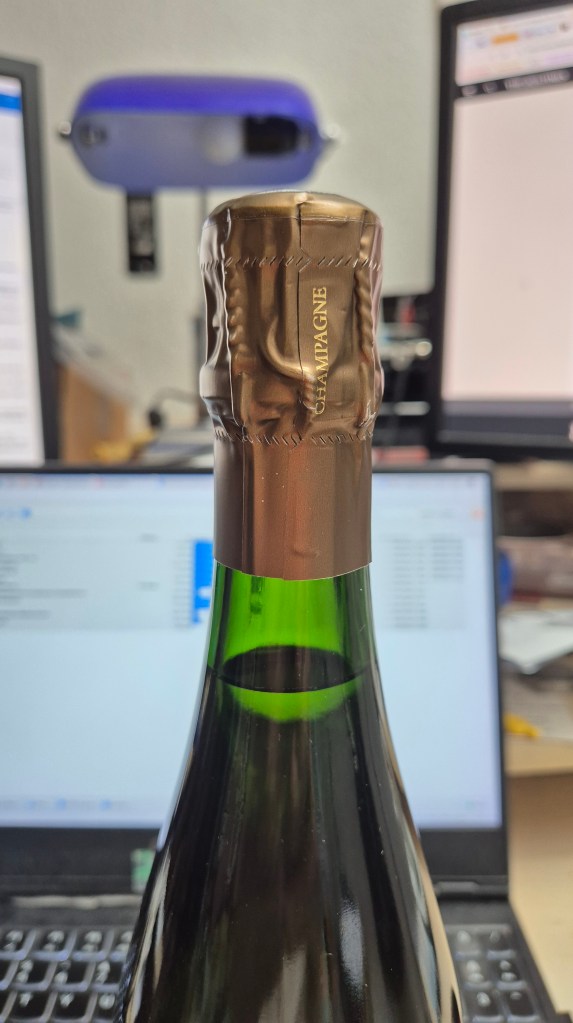
A couple of days ago I took delivery of a bottle of Champagne for an upcoming tasting. It had an unusually short capsule which revealed the fill level, and this seemed rather low (see photo).
Champagnes normally have a very long capsule; it may almost completely cover the neck, so the fill level is hidden. Reasons given on the web for these long capsules are various and mostly not very convincing. The only appealing reason is that in olden times it was not easy to ensure a uniform fill level in the few seconds available to add the liqueur d’expédition after disgorgement, and the long capsule hid this variation. That no longer applies but long capsules have been preserved, because they are traditional and because they look classy.
I wrote to the maker, attaching this photo, and received an interesting reply. They said that the ullage was satisfactory and enclosed as evidence a photo of another bottle, without the capsule, but with measurements. They also said that the importer had specifically asked for a short capsule. Perhaps this was to be environmentally friendly, but I do not know.
All this made me wonder how much ullage Champagne normally has. The second attached photo shows two other (different) bottles with the bottle of concern between them. There is very little difference in the size of the air bubble. So it appears to be normal for the level to be quite a long way down the neck. I will check when I open Champagne in future.
There is some discussion on the web about Champagne ullage, the main issue being assessment of old bottles. My little investigation suggests that the level starts lower than for still wine, so a difference must be allowed for among older bottles too.
As with all research, I ended up with more questions than I started with. Does the pressure in the air gap (about 80 psi) require or create a bigger volume of air than for still wine? Could loss of pressure over time mean that the ullage actually rises (or drop less than it otherwise would)?
Can any Champagne experts out there confirm any of this and explain why Champagne is not topped up as much as still wine?

 GrapeDeal.com
Leave a comment